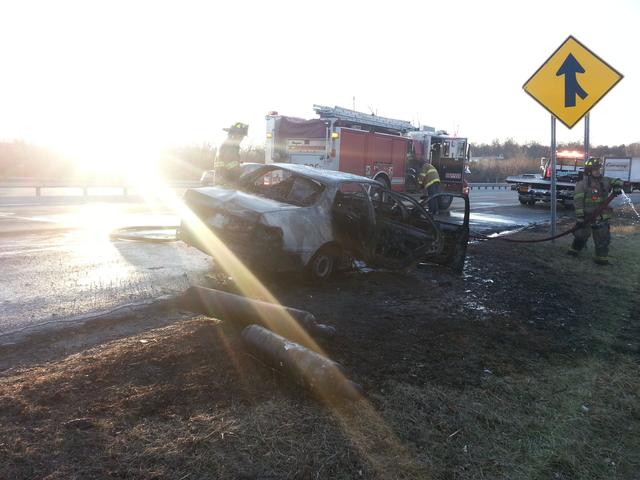
| On Wednesday, February 6, 2013 at 3:12 PM, the Purchase Fire Department was dispatched to a motor vehicle fire on Interstate 287 westbound, in the area of Exit 9A. Upon arriving at mile marker 7.2, Car 2411 observed a well-involved four-door sedan on the right shoulder and redirected units to the appropriate point of access. The driver and passenger had safely exited the vehicle and reported no special hazards other than what was described as two empty air tanks left inside the car.
Engine 240 and Engine 238 arrived together, positioning for fire attack and traffic blocking, respectively. Firefighters on Engine 240 stretched 100' of 1 ¾" hose from the front bumper discharge, achieving a quick knock down. As members overhauled the vehicle to ensure complete extinguishment, compressed oxygen and dissolved acetylene cylinders were found in the trunk. Considering the potential of explosion when compressed gas cylinders are heated, this was an alarming discovery. As a precaution, with particular respect to the lingering threat of acetylene decomposition, the cylinders were cooled for an extended period. Once removed, the cylinders were examined, showing no signs of leaks or structural damage. Based on their weight, the cylinders appeared to be empty, as reported by the vehicle occupants. The vehicle and cylinders were safely removed from the scene and all units returned to service at 4:58 PM.
Since all compressed gases are capable of creating flammable, oxygen-deficient, or oxygen-enriched atmospheres, adequate ventilation must be provided for compressed gas cylinders. Enclosed vehicles are not appropriate for storing or transporting compressed gases. Cylinders must also be properly secured with valve protection caps in place to prevent damage or opening during transport. A broken valve could result in the violent acceleration of a cylinder.
First responders must remain vigilant of the presence of such hazards, even in the most unsuspecting vehicles. Every reasonable effort should be made to identify the contents of vehicles involved in fires or accidents for the safety of all personnel on the scene. |